

At a glance
- Era
- The Buyid, Fatimid and Seljuk Era
- Region
- Egypt & Nile · Maghreb
Arts of the bookLibraries, paper and the book
Quick facts
- Domain
- Everyday life
- Kind
- Device
- First attested
- c. 974 CE · c. 363 AH
- Era
- Abbasid age
- Where
- Cairo
- Attribution
- Contested
Who made it
- al-Mu'izz li-Din Allah Ma'add ibn al-Mansur Commissioner
- al-Qalqashandi Describer
The claim and its basis
Documented: the first reservoir pen named in the sources — no surviving specimen, and its making rests on a single later literary report; the record claims priority of the account, not of an extant object.
EI2 KALAM notes in passing the Fatimid-period invention of a kind of 'fountain-pen' in Egypt; Bosworth draws the account from al-Qalqashandi's Subh al-A'sha and argues the idea's technical plausibility, while it remains a single literary witness.
Sources: Encyclopaedia of Islam, 2nd edition (Leiden: Brill, 1954–2008), 13 volumes · Bosworth, A Mediaeval Islamic Prototype of the Fountain-Pen? (1981)
Before it
- The reed pen (qalam), inkpot and pen-box
Built on it
- The modern European fountain pen
How it works
Summary
Eight centuries before the modern fountain pen, a caliph in Egypt reportedly asked for a pen that would carry its own ink — one that 'writes without an inkpot' and does not stain the hand or the sleeve. The story survives through al-Qalqashandi's great chancery handbook, and EI2 notes plainly that 'a kind of fountain-pen was invented in Egypt' in the Fatimid period. No specimen exists; it is history's earliest documented reservoir pen — by account, not by artefact {cite:encyclopaedia-of-islam-2; bosworth-mediaeval-fountain-pen-1981}.
What it is
A pen with an internal ink reservoir: the caliph al-Mu'izz li-Din Allah (r. 953-975) wanted to write for a long stretch without dipping, and without ink soiling his fingers or clothes. The account describes a pen that met both demands — the defining feature of every fountain pen since 2.
The world before it
Every scribe worked the same kit: the qalam — a reed tube cut between two knots, sliced obliquely and slit at the point — dipped constantly into the dawat inkpot. EI2 describes the craft in detail: Wasit reeds from the marshes of Iraq were best, cut on the ivory mikatta board with a long penknife, the nib's two halves deliberately unequal for each script 3.
The story
The Fatimid court — first in Ifriqiya, then in Cairo after al-Mu'izz's entry in 973 — ran one of the world's great writing bureaucracies. In that milieu, the report says, the caliph asked for a pen that would free the hand from the inkpot, and one was made for him. The account reached posterity through the Mamluk chancery writer al-Qalqashandi's Subh al-A'sha — Bosworth's 1981 article brought it to modern attention as a plausible prototype of the fountain pen 2.
The maker(s)
The caliph is named; the craftsman is not. Al-Mu'izz stands as commissioner in the report; the pen's maker — presumably a court artisan — is anonymous, and al-Qalqashandi is the describer who carried the story into the chancery literature 2.
How it works
The account does not give engineering. The principle is unmistakable: a reservoir holding ink inside or alongside the pen, feeding the nib in a controlled way so that writing continues without dipping — the same problem modern pens solve with cartridges, feeds and gravity-or-capillary channels 2.
The spread
It did not spread — that is the honest answer. One caliph, one report, no surviving object and no line of descendants. The idea slept for eight and a half centuries inside a chancery handbook while the world wrote with quills 2.
What it was built on
Everything the Islamic pen-craft already knew: the best reed stock, the perfected nib-cut, the miklama and kalamdan cases that already married pen and inkpot into one portable kit. The reservoir pen was the logical next step of a mature writing technology 3.
What was built on it
Nothing directly — the modern fountain pen is a parallel invention. Petrache Poenaru's 1827 French patent opened the nineteenth-century line that produced the cartridge pen; the connection to Cairo is the problem posed, not the design transmitted 2.
Impact on daily life
In its own day, almost none — one courtly commission. Its value to daily life is retrospective: proof that the wish to write without an inkpot, which every fountain-pen user shares, is nearly a thousand years older than the object on the desk 2.
How it changed history
It changed the history of an idea rather than of a technology: it rewrites the fountain pen's origin story from an 1827 patent back to a tenth-century caliph's request, and it testifies to the engineering ambition of the Fatimid court workshop 2.
Who invented it?
The report says an unnamed craftsman made it for al-Mu'izz — so 'the Fatimid court' is the safest attribution. Bosworth treats the account as a genuine early prototype; what cannot be claimed is priority of an object, since none survives and no second technical description exists 2.
Today
Every cartridge and piston pen in every pocket descends conceptually from the same wish. The al-Mu'izz pen itself is known only through the transmitted account — and through records like this one, which preserve the report as report 2.
Surviving examples
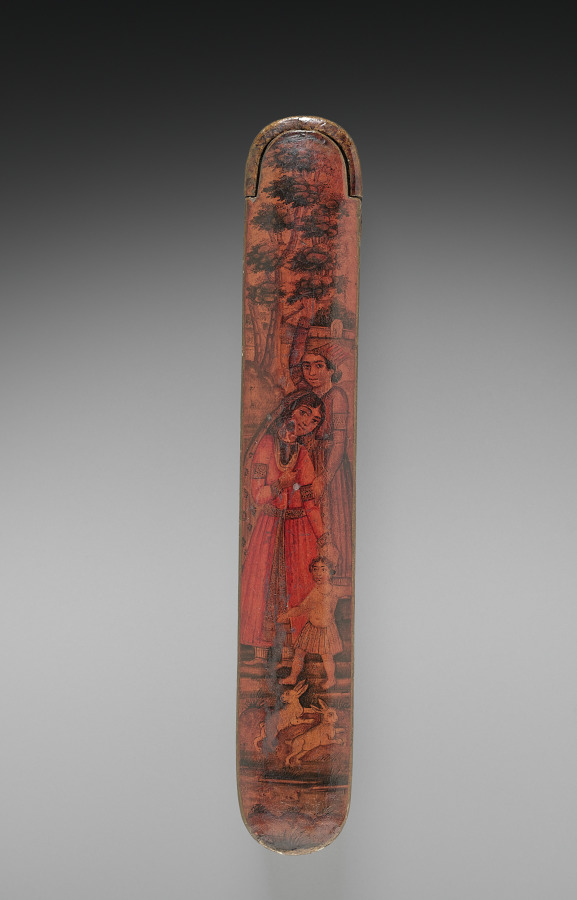
None. No Islamic reservoir pen has been found. The closest material witnesses are the pen-boxes and inkpots of the era — the qalamdan sets, like the Qajar pen-and-ink box pictured in this record, that kept pen and inkpot together 3.
In culture
The pen has always been honoured in Islamic civilisation — the crafts of calligraphy and the chancery produced a whole literature of ink, reed and nib, and the al-Mu'izz story is its most delightful entry: a king asking the impossible of a pen, and reportedly getting it 3.
For young readers
When you write with a pen that has ink inside it, you are using an idea that a caliph in Cairo asked for more than a thousand years ago: 'make me a pen that carries its ink and doesn't dirty my hands.' The books say his craftsmen did it. We have never found that pen — but the wish was real, and it finally came true for everyone.
References
- Encyclopaedia of Islam, 2nd ed., vol. IV, KALAM (the reed-pen), printed pp. 471-472 — including the note that 'in the Fatimid period a kind of fountain-pen was invented in Egypt' 3.
- C. E. Bosworth, 'A mediaeval Islamic prototype of the fountain-pen?', Journal of Semitic Studies 26.2 (1981) — bibliographic record 2.
Connections
- Described by
- al-Qalqashandi
People and things also explored
Subh al-A'sha fi Kitabat al-Insha· The Mamluk hand cannon, the midfa· Misr (Egypt)· Shamsa· al-Qalqashandi· Nujum al-Ulum (Stars of the Sciences)· Dar al-'Ilm of Baghdad (Sabur's library)· Maragha Observatory
Sources
- Encyclopaedia of Islam, 2nd edition (Leiden: Brill, 1954–2008), 13 volumes , vol. IV pp. 471-472 KALAM; bosworth-mediaeval-fountain-pen-1981
- Bosworth, A Mediaeval Islamic Prototype of the Fountain-Pen? (1981)
- Encyclopaedia of Islam, 2nd edition (Leiden: Brill, 1954–2008), 13 volumes
Cite this page
islam.museum contributors. “The reservoir pen made for the Fatimid caliph al-Mu'izz (c. 974)”. islam.museum, https://islam.museum/en/invention/fountain-pen-al-muizz/. CC BY-SA 4.0. Last updated 2026-11-20.
Improve this page on GitHub · Report an error · Help complete it · JSON