

At a glance
- Era
- The Early Abbasid Caliphate
- Region
- Levant & Iraq
Quick facts
- Domain
- Mathematics and computation
- Kind
- Method
- First attested
- c. 850 CE · c. 236 AH
- Era
- Abbasid age
- Where
- Baghdad
- Attribution
- Original
Who made it
- al-Kindi Inventor
The claim and its basis
The earliest known written description of the frequency-analysis method for breaking substitution ciphers.
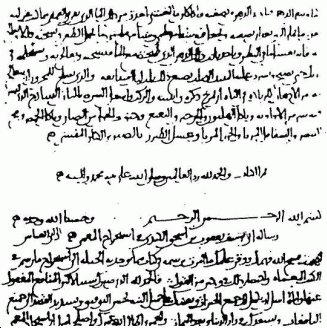
The 1987 modern edition publishes al-Kindi's text on counting letter frequencies and matching ciphertext.
Sources: Al-Kindi's cryptanalysis treatise — Damascus edition in Ilm al-ta'miya, 1987 · Encyclopaedia of Islam, 2nd edition (Leiden: Brill, 1954–2008), 13 volumes
Before it
- Substitution-cipher techniques themselves — Caesar-type ciphers — which were the target.
Built on it
- Modern cryptanalysis — from Renaissance frequency methods to computational statistical analysis.
How it works
Summary
In a short treatise on "extracting the crypted" (Risala fi Istikhraj al-Mu'amma), the ninth-century philosopher al-Kindi gave the earliest known written method for breaking a substitution cipher: count how often each letter appears in the language, count the symbols in the ciphertext, and match the two tables. What the Greeks and Romans did by intuition, al-Kindi made a countable procedure — the birth of scientific cryptanalysis 1.
What it is
A method, not a machine: given a message written in substituted letters, you exploit the fact that every language has an uneven letter distribution — in Arabic, alif and lam dominate — so the most frequent ciphertext symbol is probably the most frequent letter. From a few anchored guesses the rest of the alphabet falls into place 1.
The world before it
Ciphers were old — Caesar's shifted alphabet was a millennium older — but breaking them had been an art of lucky guessing. No surviving text before al-Kindi taught a general procedure for attack; secrecy itself discouraged writing methods down.
The story
Al-Kindi (d. c. 873), "the philosopher of the Arabs," ran the intellectual centre of early Abbasid Baghdad: philosophy, medicine, astrology, music theory — and the secret-letter sciences that a correspondence-rich bureaucracy needed. His short treatise on decipherment survived in a single Istanbul manuscript and was published in 1987 by a team of scholars who recognised it as the oldest cryptanalytic text known 1.
The maker(s)
Abu Yusuf Ya'qub ibn Ishaq al-Kindi (c. 801–873), the first great philosopher of the Islamic world, a Muslim scholar of the translation era; the record registers his faith on the museum's declared Sunni frame.
How it works
Three steps: (1) tabulate the plain-language frequency order — in Arabic alif, lam, then ba', mim, nun and so on; (2) tabulate the ciphertext symbols by count; (3) match ranks and test the guesses against word shapes. A longer text gives a stronger match, because averages converge 1.
The spread
The treatise itself went quiet — one manuscript. But the idea travelled in the craft tradition: European Renaissance cryptanalysts rediscovered frequency counting independently, and from them it entered the standard toolbox of code-breaking.
What it was built on
On the substitution ciphers it attacks — Caesar-type alphabets and the monoalphabetic tricks of earlier secretaries — and on the Arabic grammatical tradition that had already counted and ranked its own letters.
What was built on it
Everything in classical cryptanalysis builds on frequency reasoning: polyalphabetic ciphers were invented to defeat it, and every attack on them — Kasiski, Friedman — is still counting. Modern statistical decipherment is the same idea at machine speed.
Impact on daily life
It made secrecy measurable: from this point a cipher's strength could be argued, not merely assumed — the beginning of treating codes as a science.
How it changed history
It started the arms race between cipher-makers and cipher-breakers that runs through the Renaissance courts, the World Wars' code rooms and today's cryptography.
Who invented it?
For frequency analysis as a written method: al-Kindi, on the manuscript's testimony — no earlier text is known. Whether scribes practised it informally before him is unknowable 1.
Today
Every cipher puzzle, every automated codebreaker, every attack that begins "count the letters" is running al-Kindi's procedure.
Surviving examples
The unique manuscript (Süleymaniye, Istanbul) and the 1987 edition of Mrayati and colleagues 1.
In culture
He is celebrated in histories of cryptography as the founder — "the father of cryptanalysis" in the literature that begins with his treatise.
For young readers
Imagine a note where every letter was swapped for another. Al-Kindi said: in any language some letters appear more often — so count the strange symbols, guess the most common one first, and the message will open. That trick still breaks ciphers today.
References
Connections
- Invented by
- al-Kindi
People and things also explored
The Abbasid translation movement and how Arabic became the language of science· The Hindu-Arabic numerals: the decimal system's journey from India through the Islamic world to Europe· Al-Kindi's letter-frequency cryptanalysis· Al-Kindi's calculation of compound-drug degrees· Abu Zayd Ahmad ibn Sahl al-Balkhi· Farghana· al-Kindi· Accounts of hearing the Qur'an in Ibn Hisham's Sira
Sources
- Al-Kindi's cryptanalysis treatise — Damascus edition in Ilm al-ta'miya, 1987
- Encyclopaedia of Islam, 2nd edition (Leiden: Brill, 1954–2008), 13 volumes
Cite this page
islam.museum contributors. “Al-Kindi's frequency analysis for decipherment”. islam.museum, https://islam.museum/en/invention/kindi-frequency-analysis/. CC BY-SA 4.0. Last updated 2026-11-20.
Improve this page on GitHub · Report an error · Help complete it · JSON