

At a glance
- Era
- The Early Abbasid Caliphate
- Region
- Levant & Iraq
Quick facts
- Domain
- Mathematics and computation
- Kind
- Method
- First attested
- c. 800 (approx.) CE
- Era
- Abbasid age
- Where
- Baghdad
- Attribution
- Original
Who made it
- al-Kindi Describer
The claim and its basis
Earliest surviving account of letter-based cryptanalysis in TDV's assessment; a surviving-text priority, not proof about every earlier act.
The primary text supports counting, comparison and limits; TDV distinguishes earlier concealment from the surviving treatise. The maker's disputed affiliation is displayed, not adjudicated.
Sources: Al-Kindi's cryptanalysis treatise — Damascus edition in Ilm al-ta'miya, 1987 · MUAMMA — Ismail Durmus, TDV · Al-Kindi — Mahmut Kaya, TDV
Before it
- Earlier concealment and the Muamma book attributed to al-Khalil
Built on it
- Treatises of Ibn Adlan, Ibn al-Durayhim and Ibn Dunaynir
How it works
Summary
Letters in a concealed message may change their names while repetition remains a clue. Al-Kindi describes counting letters in a sample of a known language, ranking them by use and comparing that ranking with the message's symbols. Numbers are not his final verdict: a short message may depart from ordinary usage, and a guess needs checking against letter combinations and context 1. TDV calls his the earliest surviving treatise on concealing and recovering messages while acknowledging earlier concealment 2. This exhibit concerns that documented method, not invention of secrecy or a supposed ability to open every cipher.
What it is
Istikhraj al-muamma means recovering what writing has concealed, as distinct from ta'miya, making a message unclear to someone unfamiliar with its method. TDV distinguishes this technical use from a literary riddle hiding a name in verse 2. Frequency means how often a letter appears in a body of text, not its numerical value or alphabetical place.
Al-Kindi combines quantitative and qualitative clues: how often does a shape occur, which letters can precede and follow it, and does the proposed reading fit elsewhere? 1. The instrument is not a metal machine or merely a memorised codebook but an explainable, repeatable procedure. A reader can see where a guess began, what strengthened it and where it needs changing.
The world before it
Concealment did not begin with al-Kindi. TDV describes older traditions and reports a Book of Muamma attributed to al-Khalil ibn Ahmad before listing later authors 2. That earlier book's text was not read here; an ordered list of names is not evidence that a specific procedure passed between them.
Al-Kindi's own introduction says earlier philosophers and thinkers used unfamiliar signs to restrict access to their books, and that recovery can help readers understand them 3. The context is wider than a battlefield: concealed writing might carry knowledge or correspondence. The opening read names no intercepted enemy message and supplies no intelligence victory to invent for a more dramatic story.
The story
The treatise belongs to al-Kindi's Abbasid world, whose biography describes court connections and scholarly work in Baghdad 4. It addresses Abu al-Abbas and says it answers a request for an accessible explanation of recovering what concealed books record 3. The museum preserves that address; a modern footnote identifying the addressee is not the author's dated signature.
The record therefore uses the ninth century rather than manufacturing an exact invention year from a modern edition or a possible caliph's reign. The text read appears in volume one of Ilm al-ta'miya wa-istikhraj al-muamma ind al-Arab, the Damascus 1987 edition identified by TDV 5. Composition, manuscript copying and modern editing are different dates and different historical questions.
The maker(s)
Al-Kindi is the author named in the text, and TDV confirms the attribution and its status as the earliest surviving treatise of this kind 6 2. His record role is “describer”. That does not turn a manuscript copyist or modern editor into the method's inventor, or prove that no earlier knowledge existed and was lost.
Affiliation is displayed on his person page. Mahmut Kaya describes al-Kindi's defence of Islam and rejects shared questions as sufficient proof of Mu'tazili membership, while reporting and challenging Walzer's and de Boer's contrary classifications 7. The museum uses its Sunni frame with the disagreement marked, not as a documented personal declaration of a particular school. Those contrary positions are reported through Kaya, not from reading the scholars' original books.
How it works
First, identify the message's language. The text calls for a sample in that language, approximately a skin's worth or similar, counting each letter type and ranking the types from most frequent downward 8. It does not compare every language in the world with one universal Arabic table, but known usage with a message in the same language.
Next, classify the concealed message's shapes and count them. Match the most frequent shape to the highest-ranked sample letter, the next to the second, and continue 8. Changing a shape need not remove the linguistic regularity carried by the text. Numbers become evidence where the strange appearance alone supplies little.
The author immediately qualifies this for short messages: they may not contain every letter, and a letter unusually common in one passage may be balanced by another only in a longer text 8. This is not a guaranteed minimum word count. The approximate reference sample must not become a fixed success threshold for every message.
Qualitative testing follows. If two letters are guessed, ask whether they can combine in that language; examine their neighbours and test them elsewhere. Contradictions prevent establishing a letter's identity merely because its frequency rank seemed suitable 9. Short Arabic combinations such as min, an and lam supply further clues 10.
Conventional message openings can help, but should not override stronger evidence: discard an opening-based guess if it conflicts; agreement strengthens it 11. Verse has another route, using rhyme, letter counts and metre, testing possible letters against metrical feet until sense fits 12. The method is a sequence of checks and revisions, not a magical button producing correct plaintext every time.
The spread
TDV lists works by Ibn Adlan, Ibn al-Durayhim, Ibn Dunaynir and others, relating official correspondence and expanding administrative departments to the need for concealment and recovery 2. That documents a field of writing and instruction, not a census of officials applying every step in al-Kindi's text.
The Damascus edition compares later treatises when correcting letter counts, allowing study of textual traditions and their interpretation 13. No arrow is drawn from Baghdad to every European capital: the references read identify no translator, copy or chain of quotation establishing such a route here.
What it was built on
The procedure uses knowledge of language: letter repetition, possible combinations and distinctions between prose, verse, speech and writing 14. Explaining Arabic frequency, the text distinguishes pronounced sounds from short vowels not independently represented in ordinary writing 15. What is counted is a written trace within a writing system, not every sound a person makes.
The treatise also divides concealment into simple and compound forms, discussing substituted shapes, changed positions, added null signs and combinations of operations 16. These families cannot all be reduced to single substitution. Their variety helps explain why the analyst must diagnose the kind of concealment before extending one procedure to it.
What was built on it
The treatise became part of the corpus studied by the editors of Ilm al-ta'miya, alongside Ibn Adlan and Ibn al-Durayhim, as the volume description and TDV bibliography show 17 5. This is a documented link in editing and historical scholarship, not proof that every later writer borrowed every statement from al-Kindi.
The text leaves room for development: it abbreviates compound ciphers after discussing simple forms; an editorial note reports Ibn Dunaynir's criticism of that limited treatment 18. Reading an innovation alongside what successors found incomplete is more accurate than turning early survival into perfection in every branch.
Impact on daily life
TDV connects the art with administrative correspondence and discusses modern expansion of concealment and recovery into diplomacy, trade and computing 2. The distance between these settings cannot be collapsed into crediting every modern procedure to one book. The immediate lesson is that the written language of work can be examined systematically.
A reader sees that renaming signs need not erase every trace: relationships may still reveal part of the message 1. This page is neither contemporary security advice nor a promise to compromise data. It gives no number of solved messages, financial saving or battle outcome, because the references used establish none.
How it changed history
The treatise combines counting with linguistic knowledge, checking several places and revising a guess when evidence conflicts 19. Its value as a surviving witness is that the reasoning can be followed, rather than accepting a story that someone solved a puzzle. TDV places its author at the beginning of surviving writing in this field 2.
Survival is not absolute priority: an earlier text may be lost, and TDV does report a book attributed to al-Khalil 2. The record preserves that gap instead of filling it with a civilisation's victory over another. We can describe the evidence before us; the fate of all lost knowledge does not become known because this text survives.
Who invented it?
The Islamic-history reference: Ismail Durmus in TDV credits al-Kindi with clearly distinguishing substitution from changed positions and setting out frequency, adjacency and conventional openings, calling his the earliest surviving work 2. That is a specific attribution to compare with the text, not a claim that he first concealed information.
The primary text and its limits: Counting, comparison and the short-message warning are present, but no exact invention day or proof that all earlier centuries lacked the idea 20. The maker's disputed affiliation is separately displayed through labelled readings; it does not prove or disprove a mathematical procedure.
Today
The critical edition makes the Arabic procedure readable with notes marking additions and corrections. Its editors explicitly identify bracketed headings as their own 21. Readers can distinguish the author's language from twentieth-century editorial aids.
The method is historical knowledge suitable for teaching, not a universal recipe for every encryption system. Its textual conditions include language, cipher type, enough material and cross-checks 22. The accompanying diagram is the site's relationship chain, not a reproduction of an executable plan written by al-Kindi.
Surviving examples
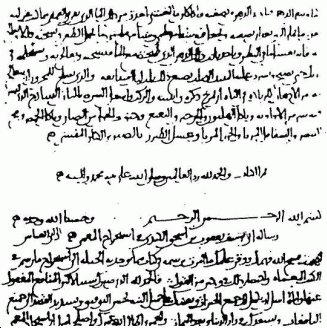
The principal witness here is the Arabic critical text with illustrations and manuscript notes. The editors explain that they compared a repeated passage in the original and used it for corrections 23. The open image displayed is a manuscript detail of the treatise's beginning, not a portrait or numerical table. Its file alone supplies no newly established copy date or shelfmark.
The author gives a count from seven leaves, but the notes emend numbers and identify three letters omitted from the enumeration 24. We describe both the example and its defects rather than copy its numbers as a complete modern measurement or permanent probabilities for all written Arabic.
In culture
Muamma covers two fields that should not be confused: secret correspondence and hiding a name in poetry. TDV distinguishes them and describes the latter's literary clues and methods 2. Both may offer the pleasure of uncovering meaning, but finding a name in a couplet is not automatically statistical analysis of a message.
Al-Kindi's introduction places usefulness in recovering meanings hidden by unfamiliar signs, not in an illustrated individual hero story 3. The museum shows writing itself. Its author remains a person within a scholarly setting, with disputed classifications and a limited surviving text, rather than an imagined face or a legend replacing evidence.
For young readers
Imagine a game replacing every letter with a sign while keeping the same sign whenever that letter returns. First ask which sign appeared most. This resembles al-Kindi's counting; it is an invented teaching game, not a historical example from his table. Remember that a short message may repeat one unusual word and mislead you.
Al-Kindi warns about short texts and asks readers to test combinations and neighbouring letters 1. A clue is not a final answer: collect more evidence and reconsider what does not fit. This is a language-and-counting game, not encouragement to read someone else's private messages.
References
- Al-Kindi, Risala fi istikhraj al-muamma, in Ilm al-ta'miya wa-istikhraj al-muamma ind al-Arab, vol. 1, study/edition by Muhammad Marayati, Yahya Mir Alam and Muhammad Hassan al-Tayyan, Damascus 1987; reading ranges are recorded with the source. 25
- Ismail Durmus, “MUAMMA”, first section, TDV, vol. 30, pp. 319–320. 26
- Mahmut Kaya, “KİNDÎ, Ya‘kūb b. İshak”, affiliation discussion, TDV, vol. 26. 27
Connections
- Described by
- al-Kindi
People and things also explored
Sources
- Al-Kindi's cryptanalysis treatise — Damascus edition in Ilm al-ta'miya, 1987 , pp. 216–218
- MUAMMA — Ismail Durmus, TDV , pp. 319–320
- Al-Kindi's cryptanalysis treatise — Damascus edition in Ilm al-ta'miya, 1987 , pp. 213–214
- Al-Kindi — Mahmut Kaya, TDV , biography
- MUAMMA — Ismail Durmus, TDV , bibliography
- Al-Kindi's cryptanalysis treatise — Damascus edition in Ilm al-ta'miya, 1987 , p. 213
- Al-Kindi — Mahmut Kaya, TDV , Mu'tezile section
- Al-Kindi's cryptanalysis treatise — Damascus edition in Ilm al-ta'miya, 1987 , p. 216
- Al-Kindi's cryptanalysis treatise — Damascus edition in Ilm al-ta'miya, 1987 , p. 217
- Al-Kindi's cryptanalysis treatise — Damascus edition in Ilm al-ta'miya, 1987 , pp. 217–218
- Al-Kindi's cryptanalysis treatise — Damascus edition in Ilm al-ta'miya, 1987 , p. 218
- Al-Kindi's cryptanalysis treatise — Damascus edition in Ilm al-ta'miya, 1987 , p. 219
- Al-Kindi's cryptanalysis treatise — Damascus edition in Ilm al-ta'miya, 1987 , p. 236
- Al-Kindi's cryptanalysis treatise — Damascus edition in Ilm al-ta'miya, 1987 , pp. 215–219, 237–241
- Al-Kindi's cryptanalysis treatise — Damascus edition in Ilm al-ta'miya, 1987 , pp. 236–237
- Al-Kindi's cryptanalysis treatise — Damascus edition in Ilm al-ta'miya, 1987 , pp. 220–226
- Al-Kindi's cryptanalysis treatise — Damascus edition in Ilm al-ta'miya, 1987 , title page
- Al-Kindi's cryptanalysis treatise — Damascus edition in Ilm al-ta'miya, 1987 , p. 224
- Al-Kindi's cryptanalysis treatise — Damascus edition in Ilm al-ta'miya, 1987 , pp. 216–219
- Al-Kindi's cryptanalysis treatise — Damascus edition in Ilm al-ta'miya, 1987 , pp. 213–219
- Al-Kindi's cryptanalysis treatise — Damascus edition in Ilm al-ta'miya, 1987 , p. 213 note
- Al-Kindi's cryptanalysis treatise — Damascus edition in Ilm al-ta'miya, 1987 , pp. 216–219, 225–226
- Al-Kindi's cryptanalysis treatise — Damascus edition in Ilm al-ta'miya, 1987 , p. 201
- Al-Kindi's cryptanalysis treatise — Damascus edition in Ilm al-ta'miya, 1987 , pp. 235–236
- Al-Kindi's cryptanalysis treatise — Damascus edition in Ilm al-ta'miya, 1987
- MUAMMA — Ismail Durmus, TDV
- Al-Kindi — Mahmut Kaya, TDV
Cite this page
islam.museum contributors. “Al-Kindi's letter-frequency cryptanalysis”. islam.museum, https://islam.museum/en/invention/frequency-analysis-al-kindi/. CC BY-SA 4.0. Last updated 2026-11-05.
Improve this page on GitHub · Report an error · Help complete it · JSON