Saved on this device only — nothing is sent anywhere.
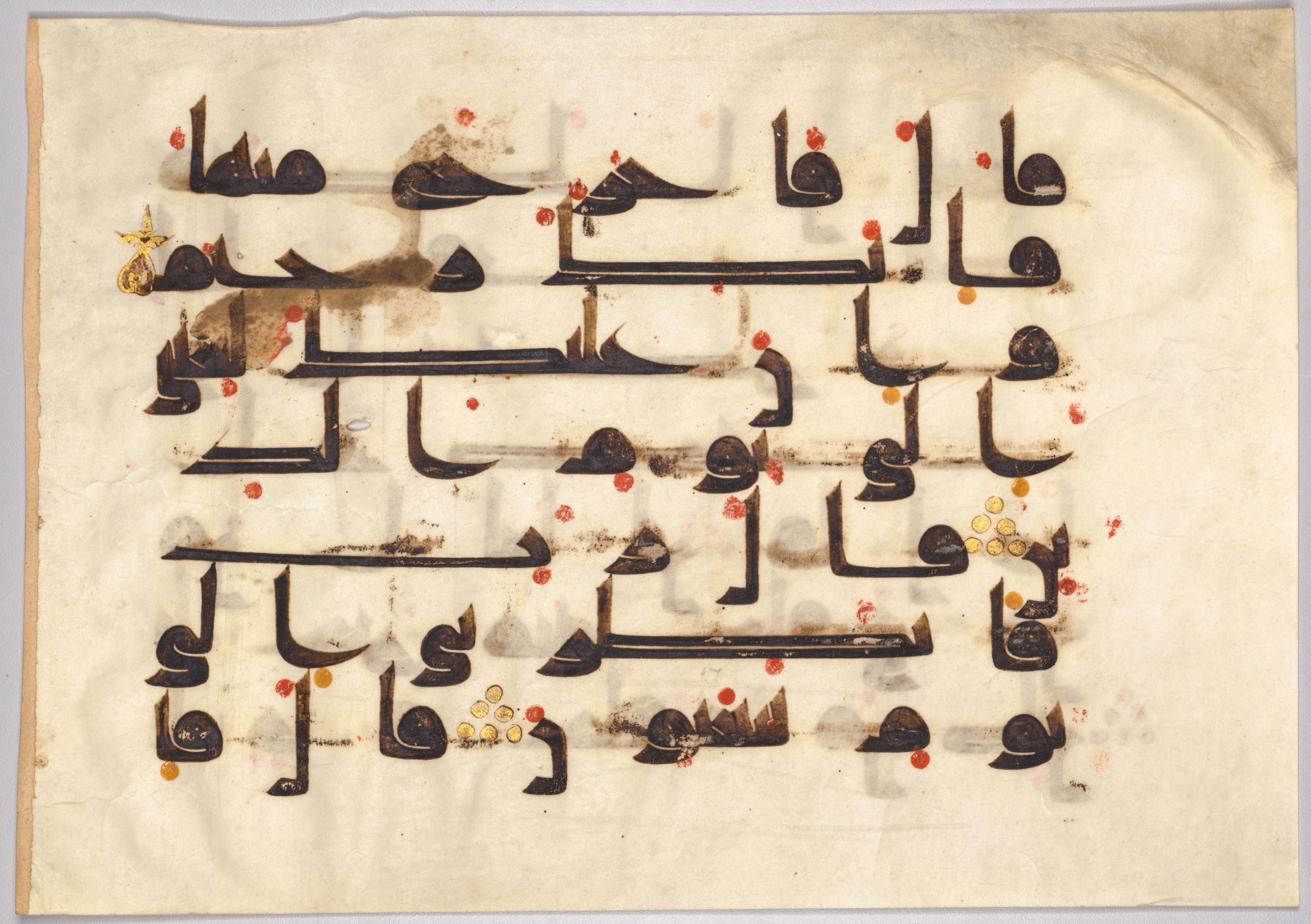
Kufic Qur'an folio, Cleveland Museum of Art: red vowel dots, gold verse markers
ورقة مصحف كوفية، متحف كليفلاند: نقاط حركات حمراء وفواصل ذهبية
A photograph of a Qur'an folio of the Cleveland Museum of Art, 1933.493.b, dated by the file page to about 800 CE. The museum's text says it is written in the oldest style of Arabic calligraphy, called Kufic, used in the earliest surviving copies; that the wide page suits elongated, horizontal strokes; that vowels are indicated by red dots; and that triangles of gold dots mark the end of each verse. It serves as a clear example of the angular, widely spaced Kufic hand used for early mushaf copies, for comparison with the later cursive scripts. It is useful for the story of dotting and vowelling: it lets the reader see, on one real page, how short-vowel marks were added to the consonant skeleton as coloured dots and later as signs. On Wikimedia Commons the file is dedicated to the public domain under CC0.
Depth
At a glance
Wikimedia Commons file "Clevelandart 1933.493.b.jpg" by Unknown, CC0, https://commons.wikimedia.org/wiki/File:Clevelandart_1933.493.b.jpg · Licence: CC0 · Open full image
This entry is a record so far, without an article. The facts and connections below come from the museum's data.
islam.museum contributors. “Kufic Qur'an folio, Cleveland Museum of Art: red vowel dots, gold verse markers”. islam.museum, https://islam.museum/en/media/kufic-cleveland-red-vowel-dots/. CC BY-SA 4.0. Last updated 2026-11-15.