

At a glance
- Region
- al-Andalus & Europe
Quick facts
- Domain
- Astronomy and its instruments
- Kind
- Instrument
- First attested
- c. 1000 (approx.) CE
- Era
- Abbasid age
- Where
- Toledo
- Attribution
- Improvement
Who made it
- Al-Zarqali Improver
The claim and its basis
A universal plate within the astrolabe tradition, not absolute priority for all astronomical or universal instruments.
Puig attributes the zarqaliyya and treatises to al-Zarqali and distinguishes the ordinary astrolabe; Bir et al. explain structure and projection.
Sources: Al-Zarqali — Roser Puig, BEA · Marrakushi's zarqaliyya production guide — Bir et al. · Astrolabe — Bibliotheca Alexandrina Antiquities Museum · Saphea, LAD2019.001 — Louvre Abu Dhabi · Cordoba display copy of the azafea — Codex photograph
Before it
- Planispheric astrolabe with latitude plates
Built on it
- Treatises, translations and Marrakushi's account
How it works
Summary
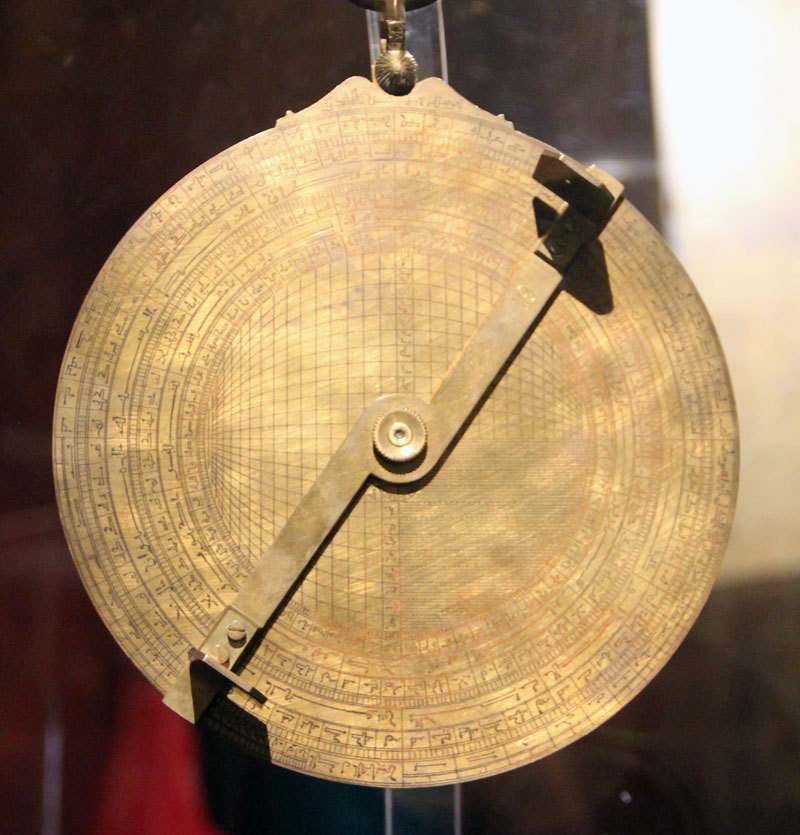
In 11th-century Toledo, Ibrahim ibn Yahya al-Zarqali developed an astronomical plate that did not require a replacement horizon plate whenever the observer changed latitude; it became known as the zarqaliyya and, in European usage, the saphaea 1. This was an improvement within the astrolabe tradition, not invention of the astrolabe from nothing or proof that every later universal instrument descended from it 3. Universal means applicable across latitudes, not a machine that discovers location and time without knowledge or interpretation 2. The photograph shows a display copy in Cordoba, not an object authenticated as al-Zarqali's own work 4.
What it is
The plate is a geometrical representation of the sky on a disc, with lines for moving between coordinate systems and a ruler representing the horizon 1. An ordinary planispheric astrolabe carries a rotating star-and-zodiac network above a plate appropriate to a particular latitude; the zarqaliyya instead combines coordinate grids on its surface, without that rotating network on the front 5.
The disc is not a photograph of the sky: it represents angular relationships and circles projected from an imagined sphere onto a plane 6. Coordinates are different addresses for the same position, expressed relative to the celestial equator, the ecliptic or the observer's horizon 7. The instrument organizes these relationships for calculation, but a person still chooses the inputs and reads the marks 2.
The world before it
The difficulty was not absence of earlier astronomical instruments: an ordinary astrolabe's horizon was drawn on a plate associated with a particular latitude 8. Moving north or south changes the horizon's relationship to the celestial sphere, requiring a suitable plate 6. The universal plate addresses a design question: could a different representation allow one disc to serve multiple latitudes? 2
The zarqaliyya remains part of astrolabe construction and spherical geometry; the study compares the projections by their viewpoints and coordinate representation 9. Its story does not begin with a sky previously beyond calculation, nor erase earlier work because a new solution relaxed one instrument's constraint 10.
The story
Roser Puig describes al-Zarqali as a Toledan instrument maker who taught himself astronomy and worked with Said al-Andalusi under the city's ruler al-Mamun 1. This was the 11th-century ruler of Toledo, not the Abbasid caliph who lived centuries earlier 1. Bir and colleagues connect his prominence with precision craftsmanship and participation in observation 11.
Puig reports a 14th-century Egyptian witness to a lost work by Said: al-Zarqali constructed an instrument called al-zarqala for al-Mamun in 1048/1049 and wrote 100 chapters on its use 1. This is a report transmitted through a later witness, not a foundation document independently read by this museum or a signature dating every plate variant; the record therefore dates the design to the 11th century rather than applying that year indiscriminately 1. The different treatises also show an instrument accompanied by explanation and teaching, not an isolated disc 12.
The maker(s)
Al-Zarqali is the improver of this particular design and author of treatises about it; Puig distinguishes his observations, tables and other instruments from the universal plate 1. The equatorium representing planetary circles, for example, is another instrument: its treatment of Mercury must not become an explanation of the plate's mechanism 1.
The Bibliotheca Alexandrina Antiquities Museum explicitly names him in its section on Muslim astronomers: a cited biographical classification, not an inference from name or country 13. The browser's Sunni default is a declared presentation rule, not a quotation asserting that he personally professed a particular legal school; neither the institutional account nor Puig's biography supplies such a personal declaration 13 1.
How it works
The change begins with projection: Puig describes replacing the standard astrolabe's equatorial stereographic projection with a meridian projection onto the solstitial-colure plane, viewing from the equinox points and combining the representations 1. Put simply, a different geometrical arrangement maps the celestial sphere to the disc; the sky itself has not changed 9.
The front combines equatorial and ecliptic grids: the first represents right ascension and declination, the second longitude and latitude relative to the ecliptic 7. A horizon ruler allows representation of the third system, altitude and azimuth associated with the observer's location 14. Lines and marks thus support conversion between celestial addresses without engraving a separate horizon plate for each latitude 6.
The study explains that circles on the sphere become circles or straight lines in this projection and that angles are preserved, making the drawing useful for calculation 15. Reading precision is not unlimited: its construction discussion recommends a size that makes marks distinguishable, with different graduation marks for different intervals 16. Fine engraving does not mean all surviving instruments have identical dimensions 17.
Puig distinguishes functions on the back, including a trigonometric quadrant and a circle associated with the Moon's distance; Bir and colleagues discuss altitude, calendar, zodiac and sine scales there 1 18. Without examining the photographed copy, every visible curve should not be assigned a specific function: photographs show particular objects, whereas treatises describe designs that can differ 4 1.
The spread
The evidence here concerns circulation of texts and knowledge, not sales: Puig identifies a Castilian translation of the zarqaliyya treatise and Latin and Hebrew translations of the shakkaziyya treatise 1. Bir and colleagues describe its presence in Marrakushi's work on timekeeping, with construction and operating guides in separate sections 19. This article relies on scholarly identification of those translations, not independent readings of their manuscripts 1.
That distinction prevents drawing one European route for everything: transmission of a zarqaliyya book is not automatically transmission of identical shakkaziyya details or every other “universal” instrument 1. The pages read do not count workshops and users or date acquisition by every port 20.
What it was built on
The technical comparison starts with the planispheric astrolabe, its local horizon plate and rotating star network, alongside knowledge of projections and spherical relationships 21. The improvement retains the astronomical problem while rearranging coordinate representation and the ruler so that a single latitude no longer constrains the plate 2. This is an explainable design relationship, not identification of one physical prototype al-Zarqali copied 22.
The record does not list every earlier astrolabe inventor: the technical pages read do not establish an uninterrupted chain of workshops with every link identifiable 23. The particular contribution remains clear without suppressing the older instrument's history 2.
What was built on it
Puig presents the shakkaziyya as a simplified form in Marrakushi's account, reducing parts of the ecliptic grid and differing from the more elaborate zarqaliyya on the back 1. This distinguishes named variants in that reference, rather than declaring every later universal astrolabe a direct descendant of one object 1.
Further evidence includes preservation of Marrakushi's construction account and its modern study and drawing, the subject of the 2020 article 24. These witnesses do not authorize an undocumented family tree extending to every modern navigation instrument 23.
Impact on daily life
The identifiable practical change is reduced need for different horizon plates when observing latitude changes; it matters to someone moving a calculation between locations 25. It does not remove the need for coordinate information, a ruler and scale reading: the device organizes relationships for a human user 2.
The study connects these instruments with calculation of time and place rather than metal ornament alone 26. The sources read do not establish money or minutes saved, or numbers of sailors carrying one; a design advantage cannot be turned into unsupported statistics 20.
How it changed history
The plate brings craft, geometry and explanation together: sources preserve long treatises, translations and a later construction account, not only a remembered name 1 27. These document teachable knowledge moving between languages and scholarly settings, a narrower claim than one instrument creating all European navigation 1.
The comparison also shows improvement through representing a known problem differently: celestial angles remain the subject, but their arrangement on a portable readable surface changes 28. This describes a documented technical advance, not civilizational superiority or erasure of translators and copyists 1.
Who invented it?
The claim is specific: Puig and Bir's team attribute the zarqaliyya and treatises to al-Zarqali and explain the departure from ordinary astrolabes 1 29. The browser therefore records an improver, not inventor of every astrolabe or every latitude-independent solution 2.
Four dates must remain distinct: design, composition of a treatise, copying a manuscript and manufacture of a surviving object; one does not automatically date the others 1 30. Nor does the 2012 photograph date manufacture of its display copy or authenticate it as the Andalusian original 31. The design attribution can remain documented while those limits stay visible 1.
Today
Louvre Abu Dhabi lists a brass saphea, LAD2019.001, ca. 1224, diameter 28.3cm, possibly produced in Andalusia, and described as on display when consulted 30. That catalogue does not establish that al-Zarqali made it or that its manufacture dates the invention 30.
The photograph selected here shows a display copy at Torre de la Calahorra in Cordoba according to its photographer's description; the museum has not adopted that description's claim about an original elsewhere as an up-to-date provenance record 4. An idea can be encountered in a metal exhibit and studied in a book without equating a teaching copy with a historical original 4 32.
Surviving examples
Textual witnesses include the treatises and translations Puig distinguishes and Marrakushi's account discussed in the modern study; the original manuscripts were not independently examined for this record 1 33. Note 34 on p. 52 of the study identifies an instrument in the Bibliotheque nationale de France used for one drawing, but publication does not automatically license its modern photograph 34.
The Louvre object and licensed Cordoba-copy photograph are different witnesses, not authenticated views of the same object 30 4. Keeping them separate prevents an attractive image from standing in for missing ownership or dating evidence 4.
In culture
European names retain traces of transmission: Puig discusses variants of al-Zarqali's name and the plate treatises, while the photograph's caption calls the copy an Azafea 1 4. A name is a linguistic and scientific trace, not sufficient evidence for dating each object bearing it 1. The sources used do not document a particular film or novel featuring this plate, so none is invented here 35.
For young readers
Imagine a sky map whose horizon changes as you travel north or south; an ordinary plate suits a particular latitude 6. Instead of carrying a plate for every location, al-Zarqali used grids and rulers adjustable across latitudes 1. Universal does not mean it knows your location by itself: a person still reads and calculates, while the lines connect different ways of describing the sky 2.
References
- Roser Puig, al-Zarqali biography, pp. 1258–1260: instruments, treatises and translations.
- Bir, Bütün, Kaçar and Akın, zarqaliyya guide, pp. 40–41,46–54; the rest of the study was not read in full for this record.
- Bibliotheca Alexandrina Antiquities Museum, named Muslim-astronomers section: biographical classification.
- Louvre Abu Dhabi, LAD2019.001, object fields.
- Codex photograph and metadata, display copy; CC BY-SA 3.0.
Connections
- Improved by
- Al-Zarqali
People and things also explored
Sources
- Al-Zarqali — Roser Puig, BEA , pp. 1258–1260
- Marrakushi's zarqaliyya production guide — Bir et al. , pp. 47–53
- Marrakushi's zarqaliyya production guide — Bir et al. , pp. 41, 47–49
- Cordoba display copy of the azafea — Codex photograph , description
- Marrakushi's zarqaliyya production guide — Bir et al. , pp. 47–48
- Marrakushi's zarqaliyya production guide — Bir et al. , pp. 49–53
- Marrakushi's zarqaliyya production guide — Bir et al. , pp. 51–53
- Marrakushi's zarqaliyya production guide — Bir et al. , pp. 40, 49
- Marrakushi's zarqaliyya production guide — Bir et al. , pp. 49–52
- Marrakushi's zarqaliyya production guide — Bir et al. , pp. 41, 49–53
- Marrakushi's zarqaliyya production guide — Bir et al. , p. 46
- Marrakushi's zarqaliyya production guide — Bir et al. , p. 47
- Astrolabe — Bibliotheca Alexandrina Antiquities Museum , The Role of Muslim Astronomers
- Marrakushi's zarqaliyya production guide — Bir et al. , pp. 48, 51–53
- Marrakushi's zarqaliyya production guide — Bir et al. , p. 49
- Marrakushi's zarqaliyya production guide — Bir et al. , pp. 53–54
- Marrakushi's zarqaliyya production guide — Bir et al. , pp. 52–54
- Marrakushi's zarqaliyya production guide — Bir et al. , p. 48
- Marrakushi's zarqaliyya production guide — Bir et al. , pp. 41–42
- Marrakushi's zarqaliyya production guide — Bir et al. , pp. 41, 46–54
- Marrakushi's zarqaliyya production guide — Bir et al. , pp. 47–52
- Marrakushi's zarqaliyya production guide — Bir et al. , pp. 46–53
- Marrakushi's zarqaliyya production guide — Bir et al. , pp. 41, 47–54
- Marrakushi's zarqaliyya production guide — Bir et al. , pp. 40–41, 47–54
- Marrakushi's zarqaliyya production guide — Bir et al. , pp. 40, 49–53
- Marrakushi's zarqaliyya production guide — Bir et al. , p. 41
- Marrakushi's zarqaliyya production guide — Bir et al. , pp. 41, 47
- Marrakushi's zarqaliyya production guide — Bir et al. , pp. 49–54
- Marrakushi's zarqaliyya production guide — Bir et al. , pp. 41, 47–53
- Saphea, LAD2019.001 — Louvre Abu Dhabi , catalogue fields
- Cordoba display copy of the azafea — Codex photograph , description and date
- Marrakushi's zarqaliyya production guide — Bir et al. , pp. 47–54
- Marrakushi's zarqaliyya production guide — Bir et al. , pp. 40–41
- Marrakushi's zarqaliyya production guide — Bir et al. , p. 52 n.34
- Marrakushi's zarqaliyya production guide — Bir et al. , pp. 40–41, 46–54
Cite this page
islam.museum contributors. “Al-Zarqali's universal astrolabe plate”. islam.museum, https://islam.museum/en/invention/universal-astrolabe-al-zarqali/. CC BY-SA 4.0. Last updated 2026-11-05.
Improve this page on GitHub · Report an error · Help complete it · JSON