

At a glance
- Era
- The Buyid, Fatimid and Seljuk Era
- Region
- Levant & Iraq
Images
Quick facts
- Domain
- Mathematics and computation
- Kind
- Algorithm
- First attested
- c. 1000 (approx.) CE (derived)
- Era
- Middle period
- Where
- Baghdad
- Described in
- Al-Samawal's al-Bahir in algebra
- Attribution
- Improvement
Who made it
- Al-Karaji Improver
- al-Samaw'al al-Maghribi Transmitter
The claim and its basis
A repeatable coefficient-generation rule for powers of a sum of two parts within earlier algebra, not world priority for all arithmetic triangles.
MacTutor reproduces a mediated translation of al-Samawal's witness, including1,2,1 and1,3,3,1; DSB confirms the loss of Karaji's original computation.
Sources: Al-Karaji — MacTutor mathematical biography · Kereci — TDV encyclopaedia · Karaji and The Extraction of Hidden Waters — Ataie-Ashtiani and Simmons · Al-Samawal — MacTutor biography · Al-Samawal — Adel Anbouba, Dictionary of Scientific Biography · Jaina mathematics — MacTutor · Jia Xian — MacTutor · Pascal — MacTutor: triangle and later powers · Commons record: Pascal's triangle5.svg
Before it
- Al-Karaji's polynomial arithmetic
- Al-Khwarizmi/Abu Kamil algebra and Diophantine arithmetic
Built on it
- The textual witness in al-Samawal's al-Bahir
How it works
Summary
How can we find the numbers appearing when a sum of two quantities is multiplied by itself repeatedly? The sources attribute to Abu Bakr al-Karaji a rule generating these coefficients by adding adjacent entries in a table; al-Samawal al-Maghribi transmits the account of an original computation that no longer survives 1 2. Its setting is early-eleventh-century Baghdad algebra, but this account does not establish the particular lost text's exact composition date or writing location 1 2. We describe a bounded improvement in coefficient generation, not the invention of all algebra or the world's first arithmetic triangle 1 3.
What it is
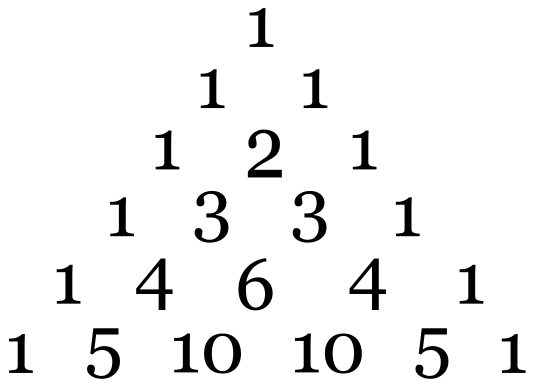
A binomial here is a sum of two parts; a coefficient records how often a particular product contributes after like terms are collected, illustrated in the transmitted account by the square's sequence of one, two and one 1. In modern teaching notation we write(a+b), whose square is a²+2ab+b²; these letters and superscripts are not a transcription of Karaji's manuscript 1. This page's particular contribution is a method for finding the next power's coefficient list, rather than another account of all the operations on composite expressions already described separately 1. The accompanying modern image displays six rows, whereas the historical witness describes a table that can be pictured as a triangle lying on its side 4 1.
The world before it
Operations on unknown quantities did not begin with Karaji: MacTutor places his work within the tradition of al-Khwarizmi and other Arabic algebraists, alongside the arithmetic influence of Diophantus 1. Al-Samawal's biography also includes Abu Kamil among the authors he studied before developing his own work 5. Outside this Arabic sequence, the history of Jaina mathematics describes rules for combinations and permutations, connections between combinations and binomial coefficients, and a triangle in a tenth-century commentary on an older work 3. That is evidence of an earlier or parallel Indian coefficient tradition, not a document showing that the particular commentary reached Karaji 3 1. Similar shapes do not by themselves supply a journey or a translation.
The story
MacTutor reports that Karaji calculated the cube of a sum in al-Fakhri, and the cube of a difference and fourth power of a sum in al-Badi; the general table construction is preserved in al-Samawal's later writing 1. Adel Anbouba's Dictionary of Scientific Biography entry places Karaji's coefficient calculation after1007, referring to an edition of al-Badi that we have not independently read 2. That reference is not treated here as the exact composition date of a complete surviving original 2. Al-Samawal admired Karaji but also identified shortcomings and developed improvements; the biographies describe al-Bahir in algebra as a youthful work that may subsequently have been revised 5 2. The preservation story is therefore a later author naming a predecessor within a larger algebraic project, not a documented personal meeting.
The maker(s)
Karaji's role in this record is improver: the repeatable generation of coefficients is associated with him within an older tradition, without world-first claims for combinations or triangles 1 3. Ataie-Ashtiani and Simmons explicitly identify the named mathematician and engineer as Muslim, but do not attest his personal religious school 6. The separately declared Sunni frame belongs to the museum; Buyid patronage and Baghdad context remain distinct from evidence of individual belief 7. Al-Samawal's role here is transmitter: his biography places the initial al-Bahir in his youth and his conversion to Islam in1163, so neither every passage's Islamic-period composition nor a personal Sunni affiliation is assumed 5 2.
How it works
The translated testimony reproduced by MacTutor begins with ones and constructs1,2,1 for the square; the extremes represent each part's square, while the middle records the product of the two parts twice 1. To obtain the next list, retain a one at each extreme, add one and two to obtain three, and then two and one to obtain another three, producing1,3,3,1 1. Generating this list does not require dividing a large factorial or independently searching for every coefficient; adjacent addition is the procedure actually described by the witness 1.
In a modern reconstruction we can name the coefficient of power n at position k as C(n,k), giving the internal recurrence C(n+1,k)=C(n,k−1)+C(n,k), with one at each boundary 1. This indexing and symbolism explain the rule; they are not the author's words or evidence that he supplied the modern definition of a zeroth-power row 1. When(a+b)³ is multiplied by(a+b), each interior term receives contributions in two ways: a preceding term multiplied by a and its neighbour multiplied by b, whose coefficients must consequently be added 1. From1,3,3,1 we therefore obtain1,4,6,4,1 for the fourth power, followed by1,5,10,10,5,1 for the fifth, the last row of the modern illustration 1 4.
Take a=2 and b=3 as numbers selected by the museum for explanation, not a historical example attributed to the author: the square gives4+12+9=25, and the cube8+36+54+27=125 1. The fourth-power list gives16+96+216+216+81=625, agreeing with5⁴ 1. This numerical check illustrates what coefficients do, but does not alone prove the rule for every power; MacTutor distinguishes the early successive reasoning from a rigorous exposition of mathematical induction 1. The scope here is finite integer powers, not an infinite series for a negative or fractional exponent 1 8.
Symmetry supplies another check on the witness's lists:1,3,3,1 reads identically from either end, as do the displayed fourth- and fifth-power rows 1 4. In the reconstruction, exchanging the names of the two parts reverses term order without changing their sum, making symmetry a teaching check rather than an attribution of a further undocumented theorem 1. The number of coefficients exceeds the exponent by one because the two boundary terms remain alongside the interior contributions 4.
The spread
The transition established by the sources read is textual: from Karaji's work to al-Samawal's account in al-Bahir, not a map of dated stations for every manuscript 5 2. Anbouba says that al-Bahir's influence on Arabic algebra is difficult to assess, suggests indirect and restricted influence on al-Kashi's Key of Arithmetic, and describes the book as apparently unknown in the West 2. These are the historian's assessments, not a museum proof that no transmission could ever have occurred 2. Nor are al-Samawal's travels in Iraq, Syria and elsewhere converted into a confirmed itinerary for this table, since the biography does not associate every journey with a copy of al-Bahir 5.
What it was built on
The operational foundation is multiplication and collection of like terms in algebra, described within Karaji's arithmetic of composite expressions 1. Multiplication supplies the coefficient's meaning, while the recurrence supplies a way to generate the next coefficients; these are not interchangeable names for the whole algebraic achievement 1. The conceptual diagram records Karaji's general expression arithmetic and earlier algebra as contexts, followed by the particular recurrence and then the witness in al-Bahir 1 5. The Indian tradition is not placed in an invented causal chain: it appears in the preceding historical comparison with the evidential limit made explicit 3.
What was built on it
The nearest documented subsequent construction is al-Samawal's incorporation of the testimony within his broader treatment of operations, equations and summations 5. For China, MacTutor describes Jia Xian's table, known from Yang Hui's1261 explanation, including the sixth-power row and the rule adding the two entries above each position 9. This is comparable work, not a dependent demonstrated to have borrowed from Karaji 9 1. Pascal's biography connects his triangle work through Wallis to Newton's extension to negative and fractional powers; the passage read supplies no route from Baghdad to that European investigation 8. The later extension consequently remains distinct from this record's finite scope.
Impact on daily life
The effect we can confidently describe concerns the calculator and learner: generating the next power's coefficients by adjacent addition and connecting them to multiplication, rather than presenting only disconnected lists of answers 1. MacTutor follows the explanation through the fifth power, allowing a reader to continue the pattern 1. The sources read do not measure reductions in working hours or market costs caused by this procedure, or establish that it became every merchant's daily tool 1 2. General benefits of arithmetic should not be assigned to this particular algorithm without evidence, nor should later mathematical applications be retroactively attributed to Baghdad users.
How it changed history
Al-Samawal's writing preserves material about a lost original calculation; the historical importance is therefore not merely the survival of a shape, but of its attribution and construction account 2 1. MacTutor highlights successive reasoning from one case to the next as an important step towards understanding inductive proof, while denying equivalence with a fully formulated modern induction principle 1. Knowing the values1,3,3,1 is consequently different from describing a procedure generating further powers and explaining their relationship to multiplication 1. We do not say that Europe or modern mathematics could not have developed without it; that counterfactual is not supported by the displayed sources.
Who invented it?
Sunni museum frame: we present a contributor with documented Muslim identity, preserving predecessors and attribution limits, without assigning a religious school the technical judgement that the triangle began here 6 3. Karaji's documented Muslim identity does not alone establish his personal school, and that distinction remains visible in his person record 6.
Academic account: the mediated translation in MacTutor attributes the general construction to Karaji through al-Samawal's testimony, while Anbouba confirms that the original computation is lost; this page does not claim an independent Arabic reading of that original or the al-Bahir edition 1 2. Earlier Indian evidence prevents assigning all binomial-coefficient history to Karaji, just as Pascal's biography explicitly denies that Pascal first studied the triangle 3 8. The more precise question is not which name cancels all others, but which procedure a particular witness attributes to a particular author.
Today
A reader can now see the recurrence in a table of coefficients for nonnegative integer powers, with a single-entry opening row representing the zeroth power in modern presentation 4. That instructional row and its symbolic definition are not credited to Karaji's formulation as transmitted in the biography 1. Separating modern illustration from historical witness allows comparison of mathematically correct rows without confusing numerical validity with documentary authenticity 4 2. Fractional and negative exponents belong to the wider development discussed in Pascal's biography in connection with Newton, not a claim that all such results occurred in the lost book 8.
Surviving examples
The principal textual witness for this attribution is al-Bahir, while the biographies state that Karaji's original computation is lost 5 2. Anbouba's bibliography lists Istanbul witnesses, including Aya Sofya2718 and Esat Efendi3155, and a modern Ahmad/Rashed edition; we have not inspected these manuscripts' images or their current catalogues 10. The article itself gives the edition's year as1972 and elsewhere1971, a discrepancy not silently resolved by guessing 10. The displayed image is a modern work by Conrad Irwin after Drini, dated2007 in the Commons record, not a leaf from any copy of al-Bahir 4.
In culture
“Pascal's triangle” is a familiar name in modern mathematical biography, but does not imply that the triangle was unknown before him; MacTutor expressly says otherwise 8. Comparing Karaji's table with Jia Xian's shows how distinct names preserve different works involving the same shared mathematical arrangement 1 9. No particular appearance in a film, postage stamp or named school textbook is attributed here, because the sources used supply no specific witness for it.
For young readers
Write1,2,1 on paper and place a one at each end of a new line; between them add1+2 and2+1 to obtain1,3,3,1 1. In the modern example these numbers tell you how to collect the results of multiplying a two-part sum three times 1. If you choose the parts2 and3, the result is8+36+54+27, or125, the same as5×5×5 1. Those example numbers are our instructional choice, while al-Samawal attributes the addition rule to Karaji 1. Remember that the illustration is a modern six-row diagram, not a picture of the scholar or his manuscript 4. Can you build the next line without first multiplying every term?
References
- MacTutor: Karaji, biography and testimony transmitted through al-Samawal 1.
- MacTutor: al-Samawal, al-Bahir and religious chronology 5.
- Anbouba: Dictionary of Scientific Biography, algebra and bibliography 2 10.
- Jaina mathematics and Jia Xian, comparative evidence, not a direct diffusion claim 3 9.
- Pascal, triangle and wider powers 8.
- TDV Karaji entry277–278 and peer-reviewed study762 for context and identity 7 6.
- Image record, source and licence, not mathematical history 4.
Connections
- Improved by
- Al-Karaji
- Transmitted by
- al-Samaw'al al-Maghribi
- Described by
- Al-Samawal's al-Bahir in algebra
- Built on
- Al-Karaji's polynomial arithmetic
People and things also explored
Al-Karaji's polynomial arithmetic· Al-Karaji· Algebra (al-jabr)· Algebra (al-jabr wal-muqabala as a discipline in al-Khwarizmi's work)· Al-Karaji's levelling and tunnel-alignment methods· Fibonacci· Baghdad· Maghreb
Sources
- Al-Karaji — MacTutor mathematical biography , Biography
- Al-Samawal — Adel Anbouba, Dictionary of Scientific Biography , algebra
- Jaina mathematics — MacTutor , combinations
- Commons record: Pascal's triangle5.svg , description
- Al-Samawal — MacTutor biography , Biography
- Karaji and The Extraction of Hidden Waters — Ataie-Ashtiani and Simmons , p. 762
- Kereci — TDV encyclopaedia , pp. 277–278
- Pascal — MacTutor: triangle and later powers , Biography
- Jia Xian — MacTutor , Biography
- Al-Samawal — Adel Anbouba, Dictionary of Scientific Biography , bibliography
Cite this page
islam.museum contributors. “Al-Karaji's binomial-coefficient recurrence”. islam.museum, https://islam.museum/en/invention/karaji-binomial-coefficient-recurrence/. CC BY-SA 4.0. Last updated 2026-11-07.
Improve this page on GitHub · Report an error · Help complete it · JSON