

At a glance
- Era
- The Mongol and Post-Mongol Era
- Region
- Egypt & Nile · Levant & Iraq
Quick facts
- Domain
- Medicine and surgery
- Kind
- Discovery
- First attested
- c. 1242 CE · c. 639 AH† (derived)
- Era
- Middle period
- Where
- Cairo
- Described in
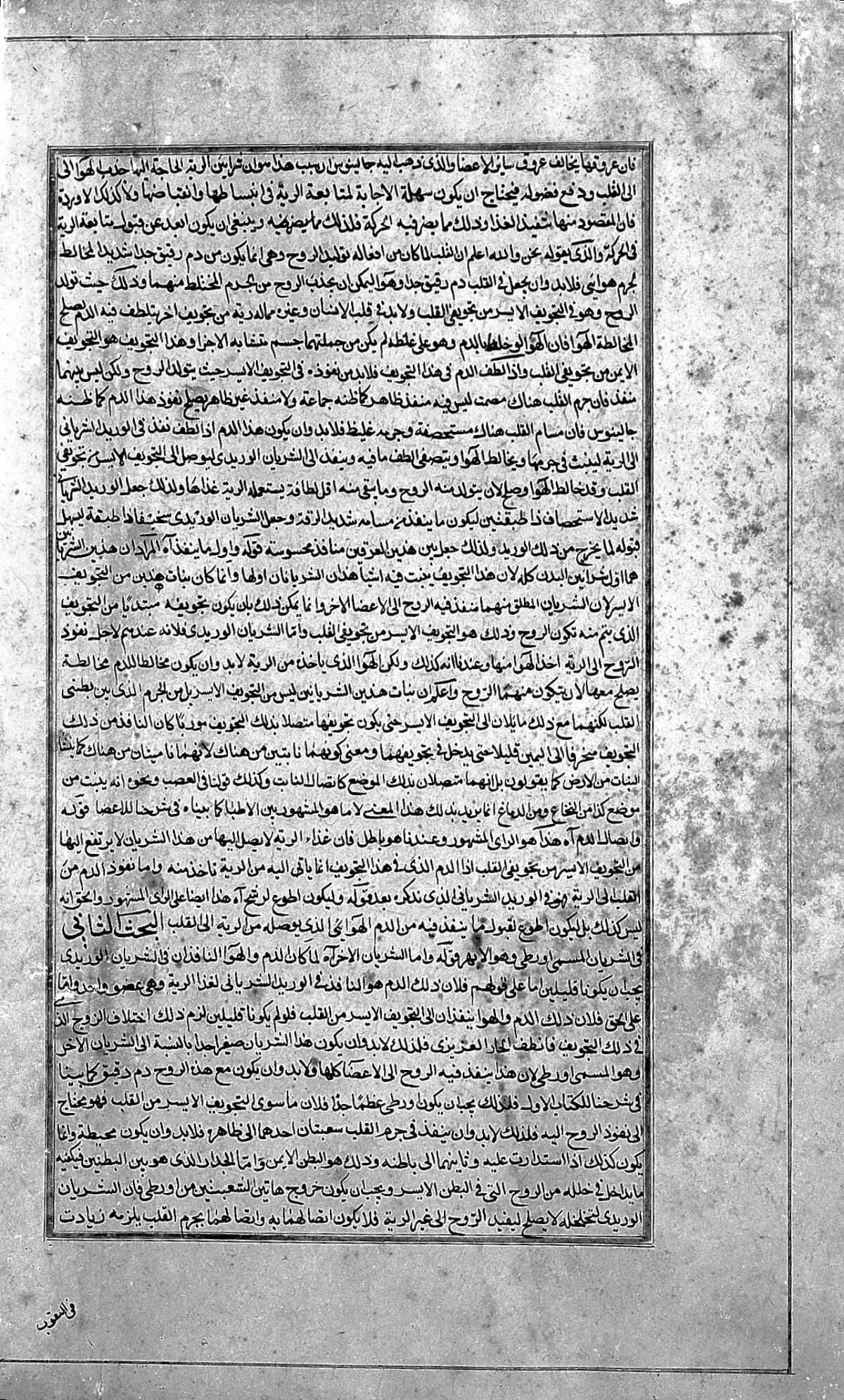
- Commentary on the Anatomy of the Canon
- Attribution
- Original
Who made it
- Ibn al-Nafis Inventor
The claim and its basis
Ibn al-Nafis was the first to reject outright the pores in the wall between the ventricles that Galen had proposed, and the first to state that all the blood reaches the left ventricle from the lung.
The text of the commentary itself, as Meyerhof translated it from the manuscripts and West reports it; the source does not dispute this priority. The open question is whether the text reached Servetus and the anatomists after him, not who described the circulation first.
Sources: John B. West, 'Ibn al-Nafis, the pulmonary circulation, and the Islamic Golden Age' (2008) · Wellcome Collection: WMS Or. 51, Ibn al-Nafis's commentary on Ibn Sina's Canon
Before it
- Galen's scheme of the blood and the vital spirit
- Ibn Sina's Canon of Medicine
Built on it
- Michael Servetus, Christianismi Restitutio (1553)
- Colombo, Valverde and Vesalius
- William Harvey (1578–1657)
- Marcello Malpighi and the pulmonary capillaries
How it works
Summary
The pulmonary circulation is the blood's route from the right side of the heart to the lungs and from the lungs to the left side. The first known description of it was written by the physician Ibn al-Nafis in his Commentary on the Anatomy of the Canon. He denied that blood crosses the wall between the ventricles through pores, as Galen had taught, and wrote that it enters the left ventricle from the lung. This was about three hundred years before Michael Servetus wrote of it in Europe. 2
What it is
It is a discovery in physiology, not a machine or a tool. As the source presents it, it has three parts:
- The wall between the two ventricles is solid, with no passage through it, visible or invisible.
- All the blood that reaches the left ventricle comes from the lung, after leaving the right ventricle.
- There are small passages between the pulmonary artery and the pulmonary vein that join them.
The third part is a prediction of what would be known centuries later as the pulmonary capillaries. 2
The world before it
The teachings of Galen and his school had held sway in medicine for about a thousand years before Ibn al-Nafis. Ibn Sina studied them and built on them to some extent in the Canon of Medicine. 2
In this system, the blood took the following path:
- Food was "concocted" in the gut and carried to the liver, where blood was formed.
- The blood reached the right ventricle of the heart.
- Part of it crossed to the left ventricle through invisible pores in the septum.
- In the left ventricle it mixed with pneuma from the inhaled air, forming the "vital spirit" that the arteries carried through the body.
- Sooty waste went back to the lung through the pulmonary vein and was breathed out. 2
The pores puzzled anatomists for more than a thousand years. Galen's scheme needed them, because nobody yet knew that a large amount of blood flows from the lungs to the heart. 2
The story
Ibn al-Nafis was born in or near Damascus and trained in medicine at its Nuri hospital. The sources differ on his birth year: West gives 1213, while the Arabic biographies used by the museum put it a few years earlier. At 23 he moved to Cairo, where he worked first at the Nasiri hospital and then at the Mansuri hospital, becoming its chief physician. 3
At 29 he published his most important work, the Commentary on the Anatomy of the Canon, which holds his views on the heart and the pulmonary circulation. He did not set out to write a book of his own. His aim was to explain Ibn Sina's anatomy. When he reached the heart, he departed from Ibn Sina and from Galen before him, and wrote that anatomy refutes those who claimed the septum was porous. 3
The West then forgot the passage for centuries. In the twentieth century a young Egyptian physician, Muhyi al-Din al-Tatawi, came across the manuscript in the Prussian State Library in Berlin. He was writing his doctoral thesis for the medical faculty of the University of Freiburg in Germany, and submitted it in 1924. He was then posted by the Egyptian Public Health Service to small provincial towns where he could do no further research, and the thesis was never published. Max Meyerhof, a physician and orientalist in Cairo, learned of the discovery, wrote about it and translated the passages, and so saved it from oblivion. 2
The maker(s)
Ibn al-Nafis was a physician and a jurist, described by West as an orthodox Sunni Muslim. 3
He studied medicine under al-Dakhwar in Damascus, as his museum record notes. He also wrote outside medicine, on law, theology, philosophy and astronomy. He wrote the Treatise of Fadil ibn Natiq, known in Latin as Theologus Autodidactus, the story of a boy who grows up alone on an island and later meets the outside world. 3
He also worked on a vast textbook of medicine, the Comprehensive Book of Medicine. He never finished it, but it was the largest medical encyclopaedia anyone had attempted in his time, and scholars still consult it. 3
He died in Cairo in 1288. 4
How it works
The account rests on two passages of the commentary, which West quotes in Meyerhof's translation.
The first is on folio 46 recto. Ibn al-Nafis writes that the blood, once refined in the right cavity, must pass to the left cavity, where the spirit is generated. But there is no passage between the two cavities, because "the substance of the heart is solid in this region and has neither a visible passage, as was thought by some persons, nor an invisible one which could have permitted the transmission of blood, as was alleged by Galen." 2
The second is on folio 65 recto and verso. He repeats that there is no passage at all between the ventricles, and that the septum is thicker than the rest of the heart to stop the blood passing. Then he says that the blood enters the left ventricle from the lung, after it has been heated in the right ventricle and risen from it. 2
In a third passage, also on folio 46, he says that there are perceptible passages, manafidh, between the pulmonary artery and the pulmonary vein. This is his prediction of the capillaries. 2
The diagram on this page sets the two schemes side by side: Galen's, in which the blood crosses the septum, and Ibn al-Nafis's, in which it passes through the lung. 2
The spread
The source does not say that the account spread in Islamic medicine after Ibn al-Nafis, and it does not trace the copies of the commentary or its readers. 1
In Europe, a different book by Ibn al-Nafis, his Commentary on Compound Drugs, was translated into Latin in 1547 by Andrea Alpago of Belluno. That translation apparently said nothing about the passage of blood through the lungs. 2
The passage on the pulmonary circulation is not known to have reached the West before the twentieth century. 2
What it was built on
What was built on it
About three hundred years later, European scholars came to the same conclusion: the blood had to pass through the lungs and could not move straight from the right ventricle to the left. The first was Michael Servetus (1511–1553), in his book Christianismi Restitutio, dated 1553. Catholics and Calvinists alike judged the book heretical, Servetus was burned at the stake in Geneva, and only three copies of the book survive. 2
The same ideas were then expressed by Realdo Colombo, his student Juan Valverde, Andreas Vesalius and William Harvey. Harvey was at first puzzled by the physiology of the pulmonary circulation. A few years before his death he reported experiments showing that liquid passes from the pulmonary artery to the left ventricle. 2
Marcello Malpighi (1628–1694) saw the pulmonary capillaries about four hundred years after Ibn al-Nafis predicted the passages. 2
Impact on daily life
The source does not record any change in the treatment of patients in Ibn al-Nafis's time. Its effect was on understanding: for Galen the lung was where waste went, and now it became the route all the blood takes between the two sides of the heart. 2
How it changed history
It was the first open break with Galen's authority on the septum, an authority that lasted upward of 1,400 years. Harvey was still taught Galen's writings at Cambridge in the late 1500s. 5
West notes that physiologists give little attention to the long period between Galen and the European Renaissance. He sees Ibn al-Nafis as a reason for historians of physiology to look at what some historians call the Islamic Golden Age. 4
Who invented it?
The source does not dispute that Ibn al-Nafis described the passage of blood through the lungs about three hundred years before anyone in Europe. The question it raises is whether Servetus and those after him knew his work. 2
- What brings the texts together: Servetus's words on the septum and the lungs resemble Ibn al-Nafis's, which might suggest he knew the earlier work.
- What sets them apart: a 1940 study by Owsei Temkin pointed out inconsistencies between the two statements.
- What reached Europe: the 1547 Latin translation of the Commentary on Compound Drugs apparently said nothing about the pulmonary circulation.
West writes that many historians believe Servetus did not know Ibn al-Nafis's work. If so, both deserve credit for the discovery of the pulmonary transit of blood, each in his own time. 2
Today
The passage of all the blood from the right side of the heart through the lungs to the left side is now a basic fact of physiology. So are the capillaries joining the pulmonary artery to the pulmonary vein, ever since Malpighi saw them. 2
Physiologists themselves write about Ibn al-Nafis today. The author of the source is one of them, a respiratory physiologist writing in the Journal of Applied Physiology. 4
Surviving examples
The surviving evidence is the manuscripts of the Commentary itself. They include:
In culture
The sources read for this record mention no place for the discovery in literature, art or popular culture. Anything that can be shown from a source will be added. 1
For young readers
Your heart has two big rooms, one on the right and one on the left, with a wall between them.
About eight hundred years ago, doctors thought this wall had tiny holes too small to see, and that blood went through them from one side to the other. The physician Ibn al-Nafis looked and said: there are no holes, the wall is solid! The blood leaves the right room, goes to the lung, and comes back to the left room. That is what doctors know today. 2
References
Connections
- Invented by
- Ibn al-Nafis
- Described by
- Commentary on the Anatomy of the Canon
People and things also explored
Ibn al-Nafis· Commentary on the Anatomy of the Canon· Birth of the scholar 'Ala' al-Din Ibn al-Nafis at Damascus, c. 607/1210· Death of Ibn al-Nafis at Cairo and his endowment of estate and books to the Mansuri maristan, 21 Dhu al-Qa'da 687/December 1288· Ibn al-Nafis becomes Chief Physician of Egypt and personal physician of Baybars, c. 658/1260· Ibn al-Nafis settles in Cairo and joins the Nasiri hospital, 633/1235· Ibn al-Nafis studies medicine under Muhadhdhib al-Din al-Dakhwar at Damascus, before 628/1230· Ibn al-Nafis composes the Theologus Autodidactus (Fadil ibn Natiq) at Cairo, c. 670/1270
Sources
- John B. West, 'Ibn al-Nafis, the pulmonary circulation, and the Islamic Golden Age' (2008) , pp. 1877–1880
- John B. West, 'Ibn al-Nafis, the pulmonary circulation, and the Islamic Golden Age' (2008) , pp. 1877–1880, §Pulmonary circulation
- John B. West, 'Ibn al-Nafis, the pulmonary circulation, and the Islamic Golden Age' (2008) , pp. 1877–1880, §Ibn al-Nafis
- John B. West, 'Ibn al-Nafis, the pulmonary circulation, and the Islamic Golden Age' (2008) , pp. 1877–1880, introduction
- John B. West, 'Ibn al-Nafis, the pulmonary circulation, and the Islamic Golden Age' (2008) , pp. 1877–1880, §Islamic science in the 8th to 16th centuries
- Wellcome Collection: WMS Or. 51, Ibn al-Nafis's commentary on Ibn Sina's Canon , catalogue record
Cite this page
islam.museum contributors. “Pulmonary circulation”. islam.museum, https://islam.museum/en/invention/pulmonary-circulation/. CC BY-SA 4.0. Last updated 2026-11-05.
Improve this page on GitHub · Report an error · Help complete it · JSON