

At a glance
- Era
- The Crusades, Ayyubids and Mamluks
- Region
- Anatolia · Levant & Iraq
Quick facts
- Domain
- Mechanics, automata and clocks
- Kind
- Device
- First attested
- between 1205 and 1206 CE
- Era
- Middle period
- Where
- Amid (Diyarbakir)
- Attribution
- Improvement
Who made it
- Al-Jazari, Ismail ibn al-Razzaz Describer
The claim and its basis
A water-and-float service sequence within an earlier automata tradition, not invention of washing, soap or robots.
Cleveland attributes picture and text to al-Jazari's book, explains soap/towel sequence and explicitly withholds certainty of construction. TDV places the engineer in an improvement tradition. This classifies a documented design, not proven material adoption or priority for modern dispensers.
Sources: CEZERÎ, İsmâil b. Rezzâz — TDV (Sadettin Ökten) · Peacock hand-washing device and verso — Cleveland 1945.383
Before it
- Ancient, Islamic and Byzantine automata traditions
Built on it
- Syrian manuscript copy of 1315
How it works
Summary
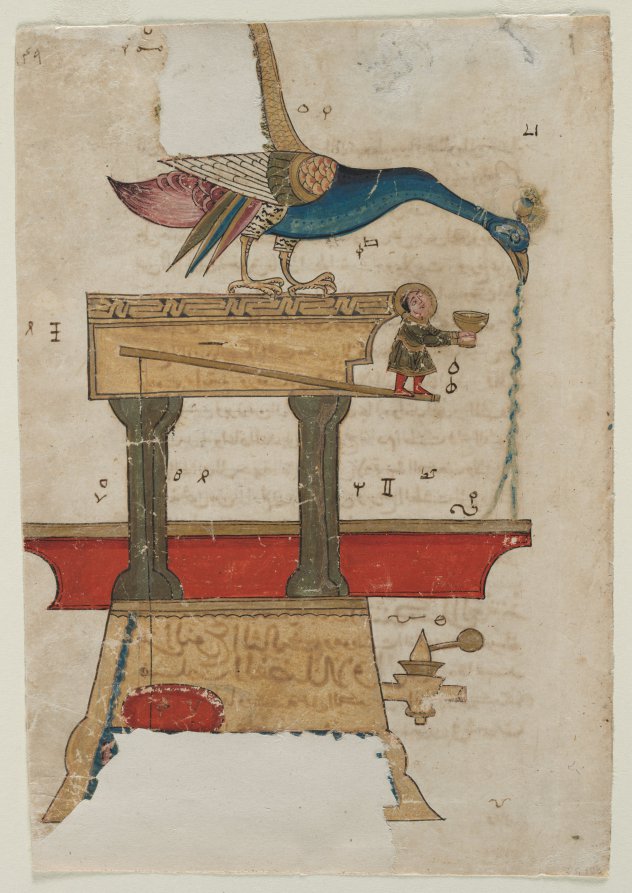
A peacock pours water, one figure offers soap and another a towel: a hand-washing design in al-Jazari's book, whose water-and-float sequence the Cleveland Museum of Art explains 1. The book belongs to his Artuqid service at Amid; the references give 1205 or 1206 for completion 3 2. Cleveland's folio preserves picture and text from a Syrian copy of 1315 4. The museum does not know for certain whether the machine was built: this is a documented design, not a surviving original device 2.
What it is
The museum describes a peacock, basin and moving service figures: the bird's mouth pours water and a figure emerges from a small door offering soap 2. The verso entry completes the sequence with a towel-bearing figure and a spigot for used water 1.
The depicted device is distinct from the surviving object. What survives is paper with colour, gold and ink, not a metal peacock whose reservoir the museum can operate 5. The figures are parts of the design, not servants hiding in the box.
The world before it
Cleveland places automata in ancient, Islamic and Byzantine traditions, rather than treating them as innovations beginning in modern Europe 2. TDV describes al-Jazari as an engineer improving inherited work in a tradition extending from Hellenistic engineering to the Banu Musa 3.
That supplies context, not proof of an identical earlier peacock. The source does not identify a preceding device with the same float and soap/towel doors, so the diagram's predecessor remains a general tradition.
The story
TDV connects the book to Nasir al-Din Mahmud's commission and al-Jazari's Artuqid service at Amid in 1181–1206 3. It describes fifty devices in six divisions, including handwashing and bloodletting vessels alongside clocks, fountains and water raising 3.
TDV dates completion to 1205, Cleveland to 1206; both remain visible as a documentary dating difference 3 2. The Syrian leaf's 1315 date belongs to the copy, not a presumed invention in Damascus 4.
The maker(s)
Cleveland attributes the design to al-Jazari's book; TDV documents the author and his work. His role here is “describer” because construction of this particular device is uncertain 2 3. “Improvement” concerns a service sequence within automata traditions, not invention of washing or soap.
TDV calls him an Islamic scholar, the Muslim identity basis here. The museum's Sunni default is explicit, not a personal school established by the art catalogue 3. Cleveland's record read here does not name this leaf's copyist; a name from the Met's similarly dated manuscript is not transferred.
How it works
The verso catalogue describes these stages 1:
- The peacock is filled with water.
- Water pours into the vessel below.
- Collected water raises a float, triggering the next movement.
- The float opens a door and a figure advances offering soap.
- More water opens a second door and another figure offers a towel.
- Used water is finally drained through a spigot.
Changing water level drives the sequence, rather than a clock announcing time like the elephant clock. Here water connects successive service actions, as the museum explains 1.
The catalogue supplies no reservoir dimensions or flow rate for a calibrated reconstruction. The text explains the sequence read; the site's diagram is a relationship chain, not a complete workshop plan.
The spread
Cleveland reports fifteen surviving manuscript copies of al-Jazari's work, ranging from the early thirteenth to late nineteenth century 2. That is the source's count of books, not fifteen peacock machines.
The Syrian leaf of 1315 witnesses copying of knowledge and image, not working devices distributed among named cities 4. Manuscript collection locations are not converted into a historic sales map.
What it was built on
The museum supplies ancient, Islamic and Byzantine automata as context. TDV describes making and assembling components, coloured drawings and letters referring to parts in al-Jazari's book 2 3. Text and picture work together.
Float, door and figure name elements of the catalogue's sequence, not intelligence choosing what to do. Priority for each individual element is not awarded to al-Jazari.
What was built on it
TDV records Donald Hill's complete English translation in 1974 and Ahmad Yusuf al-Hassan's Arabic edition in 1979 as stages in the book's study 3. Cleveland now makes recto and verso images available under CC0 6.
This documents the afterlife of text and picture. The references read identify no contemporary soap dispenser directly borrowing this design or uninterrupted manufacturing line.
Impact on daily life
The described arrangement combines pouring water, soap service, towel service and drainage in one device 1. It shows a way to connect movements to a familiar service, rather than merely moving a decorative bird.
Uncertain construction prevents claiming that it transformed a society's hygiene or saved servants a measured amount of time 2. A machine drawing is not religious or medical advice.
How it changed history
The surviving witness permits study of an automated service design in picture and text, within traditions older than modern European automata in the museum's account 7. The catalogue distinguishes knowledge of a design from certainty of manufacture 2.
That is historical value without making the peacock the cause of all later automation. Documenting a sequence in a book differs from measuring the economic or health effects of widespread machines.
Who invented it?
The Islamic-history reference: TDV places al-Jazari in engineering traditions of improvement and documents his court work and book divisions 3.
The art catalogue: Cleveland attributes the leaf to his book and explains operation while explicitly stating uncertainty about construction 7. Attribution concerns this design, not “first robot”, invention of soap or certainty that it was made.
Today
Cleveland preserves folio 1945.383, with separate records 1945.383.a for the recto and 1945.383.b for the verso 4. The drawing and text can be examined instead of relying on an imagined contemporary image.
Surviving examples
In culture
The leaf combines a coloured peacock, small figure and component letters, joining pictorial presentation with explanation of movement 10. The record read establishes no film, stamp or banknote appearance; examples belonging to another clock are not substituted.
For young readers
Imagine water collecting in a vessel and raising a float: one figure offers soap, then another a towel, and used water drains through a spigot, as the museum explains 1. These are machine figures, not people hiding inside. The museum preserves picture and text but does not know for certain whether the device was built 2.
References
Connections
- Described by
- Al-Jazari, Ismail ibn al-Razzaz
- Exemplified by
- Peacock hand-washing device — folio from al-Jazari's book
People and things also explored
Al-Jazari's elephant clock· Al-Jazari's waterwheel-driven double-piston pump· Amid (Diyarbakir)· Peacock hand-washing device — folio from al-Jazari's book· Al-Jazari, Ismail ibn al-Razzaz
Sources
- Peacock hand-washing device and verso — Cleveland 1945.383 , verso catalogue
- Peacock hand-washing device and verso — Cleveland 1945.383 , recto catalogue
- CEZERÎ, İsmâil b. Rezzâz — TDV (Sadettin Ökten) , pp. 505–506
- Peacock hand-washing device and verso — Cleveland 1945.383 , catalogue metadata
- Peacock hand-washing device and verso — Cleveland 1945.383 , API technique
- Peacock hand-washing device and verso — Cleveland 1945.383 , API images and licence
- Peacock hand-washing device and verso — Cleveland 1945.383 , recto and verso catalogues
- Peacock hand-washing device and verso — Cleveland 1945.383 , API measurements
- Peacock hand-washing device and verso — Cleveland 1945.383 , API creditline and licence
- Peacock hand-washing device and verso — Cleveland 1945.383 , recto image
Cite this page
islam.museum contributors. “Al-Jazari's peacock hand-washing design”. islam.museum, https://islam.museum/en/invention/jazari-peacock-washer/. CC BY-SA 4.0. Last updated 2026-11-05.
Improve this page on GitHub · Report an error · Help complete it · JSON